Monday, August 26, 2013

A Cavalcade of Cascading Failures

Something went screwy with the micro SD card on my phone the other day, which meant I couldn't get to the apps installed on it, nor any of the docs or photos I'd saved to it (nothing incriminating, mind you).

My phone is over 2 years old and it basically out of memory, so it's about time for a new one. But I'll be damned if I'll be forced by a glitch to get one before I'm ready.

Doing some searching around suggested a few options, but first, I had to back up the card contents to my computer.

This is when things went sideways.

The card was a Samsung 8 gig micro SD card. (With more storage than my first four or so computers combined, on a card the size of my little finger  nail.) I put it in an adapter and stuck it in the built-in SD card slot on my MacBook Pro.

It didn't mount. That wasn't so good, but not unexpected. I tested another microSD card in the adapter, and that one didn't mount, so I figured it was a bad adapter.

I bought another micro SD card, mainly for the adapter. The new adapter didn't work. And neither did the brand-new card.

I tried the new card and adapter in a few different USB card readers. Those didn't work. So this was a completely different problem.

I went back to Google, and found a thread on the Apple Support Forums with a bunch of people facing similar problems: "MacBook Pro won't read Sandisk SDHC cards since Lion 10.7.1 update."

Blindly following the suggestions in the thread, I:
  • Installed XQuartz
  • Inserted the card and just waited. A few minutes later, I got a prompt saying the card was unreadable, asking if I wanted to reformat it in Disk Utility. As I wanted to back up the contents of the card, this was not an option.
  • Fired up Parallels, to see if the card would mount under Windows 7. It didn't
  • Zapped my PRAM
  • Reset my SMC
After all this and countless reboots, I think the SMC reset did the trick, since the card mounted.

Now, I can actually get to working on the problem I was trying to get to in the first place.

Regardless, I'll probably still be trying to see if I can get a new phone out of this (I'm out from under my 2-year contract.)


Saturday, August 17, 2013

On TV, women in distress cut their hair, while men in distress shave their heads. Here, I bridge the gap.

I went and did a thing today.

Light-headed.
I got a haircut. Normally, this wouldn't be a big deal, except I've been cultivating my quasi-mullet for many years, at least partially because I enjoyed tossing my luxuriously thick locks in the face of my largely balding peer-group competitors.

According to a generally pearl-clutching piece in Atlantic this week, women in distress on TV cut their hair. While it is sure that this trope is a thing, lamenting its existence ignores the fact that there are just as many examples of the male equivalent -- men in crisis shaving their heads (or, similarly, shaving their beards) -- in pop culture to render this gender-based complaint mostly moot.

Consider:

Taxi Driver's Robert DeNiro in mohawk mode


The Walking Dead's Shane closely shorn after a human sacrifice

In real-life, we have famous examples such as Britney Spears:


And Virginia Tech shooter Seung-Hui Cho.


Anyway, while there are things about my life that I'm evaluating, and while I am trying to reduce the amount of superfluous things, sometimes a haircut is just a haircut.


Monday, July 15, 2013

37 Items From the Abbottabad Commission Report on Osama bin Laden

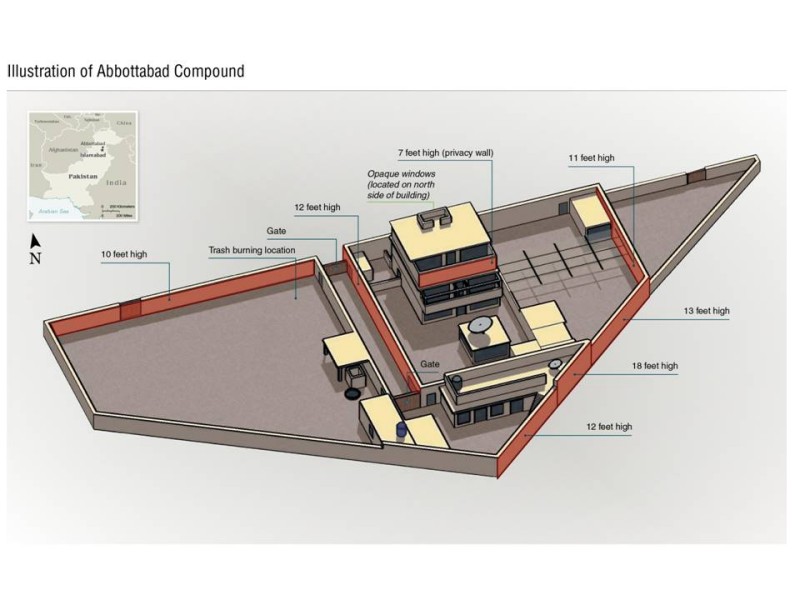
Diagram of OBL compound in Abbottabad, raided by US Navy SEALs May 2, 2011
Diagram of Osama bin Laden's compound in Abbottabad, Pakistan

Document: Abbottabad Commission Report [PDF]

Length: 336 pages

Document Date: Undated, released by Al Jazeera, July 8, 2013

Notes: 336 pages, but double-spaced and a fast read. Paragraphs are numbered, which is nice, and I refer to them below. Also, Osama bin Laden is referred to as OBL throughout. The released document is a PDF, though image-only, so text is not searchable or crawlable. All names are spelled as they appear in the report. Also, this is in the format I use for my Tumblr blog, Dumb Things I Have Read Lately, but I decided to post it here since it's way longer.

Commentary:
Since last week's release by Al Jazeera of the Abbottabad Commission's report on the May 2, 2011 US Special Forces raid on Osama bin Laden's compound in Pakistan, lots of folks have been trying to pick juicy tidbits from it.

For example, the Daily Mail noted that "Osama bin Laden wore a COWBOY HAT around the house to avoid detection." (Featuring an artist's conception of what Osama in a cowboy hat might look like.)

Beyond the goofy bits, the primary theme of the Abbottabod Commission's report is incompetence, at every level of government.

Shot glass chess set
Image by Flickr user gemsling.
Used under Creative Commons.
In fact, if you made a drinking game from the report, and took a shot every time "incompetence" showed up, you would probably die: The word shows up at least 16 separate times: paragraphs 8, 152, 203, 414, 595, 604, 676, 692, 703, 710, 727, 728, 790, and 794 (counting one "lack of competence," but not counting its appearance in questions).

In many cases, incompetence by individuals and lower-level government agencies is attributed to or exacerbated by systemic problems of ineffective institutions afflicted by corruption, conflict of interest, lack of policy guidance, and generally poor governance.

For example, the "incompetence" of a local police official, the Regional Criminal Investigation Officer, is attributed to "governance implosion syndrome." (p. 78, ¶152)

The report is breathtakingly harsh in its criticisms. It is a thesaurus of pejoratives for poor administration, including: Gross negligence, indifference, confused and incoherent, grave dereliction of duty, active connivance, unprofessional, grave lapse of professional judgment, woeful lack of efficiency, considerable ignorance, systemic failures, grossly irresponsible, shameful, dysfunctional, and policy bankruptcy.

Here are 36 other items from the report.

5-Hour Energy Shot
Image by Flickr user mikeoliveri.
Used under Creative Commons.
bin Laden's 5-Hour Energy: Also in the paragraph about the cowboy hat (p. 41, ¶48), the report noted that "...whenever OBL felt sluggish he would take some chocolate with an apple."

Like: Watching Plants Grow: "OBL personally saw to the religious education of his grandchildren and supervised their play time, which included cultivating vegetable plots with simple prizes for best performances." (p. 41, ¶49)

Escape by a Whisker: During his travels in Pakistan, OBL was clean shaven (p. 44, #55). It was also during this time that the car in which he was traveling to the bazaar was stopped for speeding by a policeman. All inside were free to go after the driver quickly settled the matter. (p. 45, ¶57)

No More TV for You: According to Maryam, wife of courier Ibrahim (al-Kuwaiti), her 9-year-old daughter Rahma was told that OBL didn't leave the house to go to the bazaar because he was too poor to buy anything, As a result, she then referred to him as "Miskeen Kaka" (poor uncle).

Rahma subsequently recognized OBL in a news report on al Jazeera, causing the ladies to then lose their TV privileges. (p. 47, ¶62-63)

In paragraph 73, the commission notes it did not find aspects of Maryam's testimony convincing.

Houseguest From Hell: Also according to Maryam, while they lived in Swat, they were visited for two weeks by a man named Hafeez, with his wife and seven children. A month later, they learned of his arrest, and his real name: Khalid Shaikh Muhammad. (p. 45, ¶58)

A Flood of Information? The Commission speculated that US pilots may have "directly or indirectly benefited from the US flood relief air operations of August-October, 2010 in the same general area" of the raid's inbound flight path, noting that the US had identified the Abbottabad compound by this time. (p. 52, ¶76)

Later, though, Director General Military Operations says during flood relief operations, US pilots were accompanied by Pakistani safety pilots to prevent deviation from planned routes. (p. 131, ¶281)

In several subsequent sections, the report similarly laments Pakistan's reliance on external assistance because of the vulnerabilities they introduce, most notably the notion that the CIA uses nongovernmental organizations as cover, exacerbated by the country's inability to properly track NGOs and their workers.

The Cable Guy: This is slightly ambiguous: Although the commission says the compound had "no television cable or telephone lines" (p. 84, ¶149), it also says a cable provider, prevented from using a wire on a pole next to the house, used another pole instead. The cable guy, later watching a Discovery Channel show about the raid, saw that OBL was watching an Arabic channel that was not offered by that provider. (p. 60, ¶93)

So, did OBL have both Dish and cable, or was the cable guy simply running the cable for a neighbor?

Foolproof Way to Cut Your Utility Bills: The utility company should have noticed that there were 4 gas meters and and 4 electric meters (supposedly  for two families) feeding the OBL compound. The power outage was deemed a fairly transparent ruse to hide excessive consumption caused by the extra, hidden, family (bin Laden's), which could have tipped off authorities. (p. 60, ¶94)

Not a Fan of Children: Pakistani Army Major Amir Aziz, one of many Pakistanis skeptical that bin Laden actually lived in the compound for years, "expressed amazement at how 15-16 children of different ages could be confined and controlled for over five years when even 2-3 children are almost impossible to control and keep quiet." (p. 76, #128)

For other reasons, (p. 78, ¶134), the commission found the Major's testimony questionable.

Accurate, but Pathetic: The commission felt that the explanation why local police agencies failed to perform their investigatory duties (they were pushed aside by more powerful and capable agencies -- the military and ISI) was "an accurate but pathetic explanation." (p. 90, ¶164)

Do the Wrong Thing: "While there can be no excuse for this 'acceptance of realities' by senior officials [in the Home Secretary office of the civilian provincial administration], it has to be noted that they functioned in a very perverse political and administrative environment in which insistence on the correct performance of duty was often rewarded with severe punishment." (p. 98, ¶187)

Twitter as Forensic Tool: The Twitter posts by Shoaib Athar (@ReallyVirtual) were deemed to be "one of the most accurate account of events" because of the timestamps> (p. 79, ¶138)

What About Rent-to-Own?: The Inspector General Police, KPK (Kyber Pakhtunkhwa), felt that properties that were owned by their inhabitants were unlikely to house militants, on the "Assumption that militants would only rent but not buy properties." (p. 93, ¶170)

Bizarro Donald Rumsfeld.
The Anti-Rumsfeld: The commission noted, "The Defence Minister's testimony was disarmingly candid. But it also revealed that he did not mind being treated by his subordinates as an irrelevance. He seemed to recognize that as an [sic] civilian he had no authority to meddle in defence and security affairs even though [he was] the Minister concerned." (p. 227, ¶546)

Bureaucratic Infighting Stops a Beating Heart: "NACTA [the National Counter Terrorism Agency, under the Ministry of Interior] was like a 'still born or aborted child.'" (p. 238, ¶576)

Hoo-ah! The commission found that the ISI investigating team, when faced with a statement by Maryam that there were unknown guests in the house shortly before the raid, dismissed it "as the nonsense of a woman." (p. 175, ¶400)

Government IT Contractors Say This Estimate Seems Low: The Pakistani Air Force Chief, when asked if the radar data from May 2 (which did not show unusual US aircraft activity) could have been manipulated, said that the PAF did not have the capability to change or manipulate the recorded data, which would take 30-40 people 6-7 weeks. (p. 154, ¶347)

Do You Call 311 or 911 to Report an Air Raid? The Air Chief also said there was no standard operating procedures to respond to phoned-in reports of incursions by hostile aircraft.

The Role of Landscaping in Counterterrorism: Trees by the OBL compound's boundary wall were cut down prior to the raid, leading some to suspect that covert CIA ground support agents did so to clear the approach for helicopters. Other reports said that OBL himself wanted them cut down to "prevent snoopers using them as cover." The Pakistani government believes a third theory, that a local landowner had them cut down and sold to pay school fees for her children. (p. 171, ¶387)

If You See Something, You Must Say Something: The Director General Military Intelligence (DG MI) felt "there ought to be a law requiring the public to inform law enforcement authorities about unusual happenings." (p. 186, ¶433)

I Want to Believe: Later, when asked about the possibility that bin Laden and his network were helped by rogue elments in the intelligence community, "The DG MI replied that 'there are no rogue elements in the intelligence establishment.' That was reassuring if not entirely convincing."
(p. 188, ¶439)

I Blame Obama: The Commission on the DG MI's assertion that if a terrorist is willing to sacrifice his life, he can't be stopped. "This, of course, is simply inaccurate. Suicide bombers may cause considerable loss of life, but in general do not have a high rate of success against VIP targets. Otherwise, people like President Obama should be long dead." (p. 190, ¶446)

On Waterboarding, Dryly: "While under detention in Pakistan, '[Khalid Shaikh Mohammad] was ill and did not divulge any information regarding OBL's location.' (He was reportedly "water boarded" almost 200 times by the CIA, which apparently had less concern for the state of his health.)" (p. 195, ¶459)

Because It's Worked So Well for the US: To combat the problem of intelligence sharing and stovepiping, "In the US, after 9/11, the Homeland Security Department (HSD) was established and all 17 security agencies were required to report to it. They all sat under one roof and met three times a day. Something like this was required in Pakistan." (p. 239, ¶582)

We Don't Think You're Completely Incompetent: On the remarks by Pakistan's Ambassador to the UK, who initially claimed the ISI and CIA worked together to trap OBL, then reversed himself: "Seldom has a High Commissioner made a more dishonest or absurd statement... The High Commissioner is an experienced diplomat... That is why, it is difficult for the Commission to dismiss his first statement as the utterance of a complete incompetent." (p. 249, ¶604)

But It Was Okay, Otherwise? On a Ministry of Foreign Affairs press release issued after the raid: "The above statement was truly shameful. It twisted and turned and went through all the convolutions of an acrobat to avoid explicitly condemning the US action and the violation of Pakistan's sovereignty, independence and territorial integrity. Indeed, the statement actually supported the American action by suggesting it achieved a common purpose. The statement dripped with confusion, fear, hypocrisy, deceit and insincerity." (p. 252, ¶609)

And Now for Noam Chomsky: The noted linguist and activist appears in the first of five paragraphs. (p. 259, ¶631)

Tell Us How You Really Feel: The commission refers to American private security contractor Raymond Davis, arrested for killing two Pakistani men he said were armed and threatening him, as "privately hired hitmen, goon thug" and "killer goon." (p. 266, ¶648)

Facepalm
Image by Flickr user benward.
Used under Creative Commons.
No Facepalm Big Enough: In the Commissions findings on why no one noticed or investigated OBL's odd compound: "The extent of incompetence, to put it mildly, was astounding, if not unbelievable." (p. 282, ¶692)

We Know You're Stupid, But Are You an Accomplice? On whether Pakistani intelligence or government was complicit: "Culpable negligence and incompetence at almost all levels of government can more or less be conclusively established by the testimonies of witnesses contained in this report. But connivance, collaboration and cooperation at some levels cannot be entirely discounted." (p. 287, ¶703)

The US as Unseen Enemy: Why did the possibility of unilateral US action come as a complete surprise? "The Pakistani military and political leadership displayed a degree of incompetence and irresponsibility that was truly breathtaking and indeed culpable." (p. 291, ¶710)

The US as Existential Threat: On being unable to stop a US incursion similar to the May 2 raid: "Submission to a military threat or military aggression from a militarily superior power without military resistance, whatever the military costs, has existential implication for Pakistan." (p. 292, ¶712)
 
Never Attribute to Malice: On why the ISI and others missed both the OBL and CIA support networks on the ground: "It was probably more a case of negligence, inefficiency and incompetence rather than complicity." (p. 299, ¶728)

We Failed to Recognize Your Pathology: On the May 2 raid as a major failure to protect Pakistan: The government failed to be aware of the "increasingly criminal and pathological nature of US policies," leading to "the greatest humiliation visited upon the country since its break-up in 1971" [when Bangladesh declared independence] (p. 301, ¶733)

The idea of the raid as a national humiliation for Pakistan, and the theme of the US "stabbing Pakistan in the back", recurs throughout the report.

The Rule, Not the Exception: On systemic failures in governance allowing lower-level incompetence that led to national tragedy: "May 2, 2011 was not a stand-alone failure. It did not represent an exception to the rule. It was the rule." (p. 305, ¶744)

Fences -- yes. Minefields -- no: The commission recommended several actions to strengthen border security. Besides stronger border controls throughout Pakistan to track the passage of foreign NGO employees, they also recommended increasing security on the border with Afghanistan. However, minefields were specifically recommended against.  (p. 331, ¶783)

As a whole, the recommendations advocate for a series of broad measures to revamp the bureaucracy, eliminate corruption, redefine civil-military relations, and generally improve civilian governance and institutions.

Although I am not an expert in Pakistani internal politics, implementation of these recommendations seems unlikely.

Thursday, July 11, 2013

Eyewitness Account of a Power Outage at the Gym

535 pm, EDT: The lights inside the gym flicker, then die. The silence ends the white noise from the air conditioning and piped-in XM Radio broadcast, propagating the sounds of grunting at the weight stacks and heavy breathing throughout.


A few policy-minded folks are concerned at first, but see that emergency lights and iPods continue to function, ruling out a decapitating EMP attack. They relax and focus on completing their workouts.

The summer sun still shines and the government-mandated emergency lights illuminate the dark corners of the locker rooms, so most exercisers focus on maintaining their age-appropriate target heart rates.

541 pm, EDT: A few nervous laughs are heard, competing with the non-electrically-amplified exhortations from the cardio kickboxing instructor in the main activity room (initially confused with screams of pain and distress from the child care room, with their now-silenced DVD players)

Although the ceiling fans and HVAC systems have ceased to function, the temperature and humidity have not risen noticeably. Morale remains high.

549 pm, EDT: Cardio exercisers continue with their routines, even though their heartrates are now untracked. Some machines, like the treadmills, are stilled by the lack of power, but others, like the bikes, ellipticals, and rowing machines, are mostly unaffected. Some even generate their own power. However, the exertion causes the temperature to creep up steadily. Even then, hot yoga aficionados rejoice.

555pm, EDT: Crossfit and P90 adherents, initially cocky and upbeat, swoon suddenly due to their lack of bodyfat reserves. They are immediately set upon and consumed by calorie- and protein-hungry powerlifters, with BodyPump and Yoga students stealthily swooping in to scavenge the remains.

610pm, EDT: An odd situational awareness envelopes all. Workout cliques, previously implicit and unstated, take explicit form, aligning closely to calorie consumption patterns. Dilettantes and gift-certificate recipients are the first to perish, followed closely by seasonal joiners.

Those who are unable to impose their will on others, such as Zumba and Body Sculpt aficionados, ally themselves with casual and sport-specific weightlifters. All survivors have long since raided the free weights and machine accessories for parts that they can fashion into hand weapons.

6:20pm, EDT: The survivors find themselves living under an uneasy truce. The few surviving non-athletes are employed either as body servants or court jesters.

6:34pm, EDT: This reporter is able to make his escape and report his findings, after completing his flashlight-assisted shower ritual. May God have mercy on his soul.

Wednesday, June 26, 2013

The Cracked.com Daily Checksum

For a while, I've felt that Cracked should actually be called Lists, since most of their featured content consists of clickbait-y numbered lists that aspire to virality (unnecessarily split into two or more pages for doubled page views, but that's another issue).

Trivia: Did you know that Cracked was originally a magazine, which was a thing that people used to buy to read while on the toilet or an airplane?
None of that is a new thing; content programmers and copywriters have known for ages that people like numbered lists. (American Top 40 and Letterman Top Ten, anyone?)

(During my AOL promo-writing days, there was an additional wrinkle that was taken as testing-validated gospel that odd-numbered lists performed better than even-numbered ones.)

Anyway, even knowing all this, I was surprised when I browsed yesterday through my soon-to-be-sunset Google Reader, when I saw that literally every feature article on the Cracked.com RSS feed was a numbered list:


"6 Mind-Blowing Images That Nature Produces Every Year."

"23 Jokes That Never Made It Into Our Best Videos."

"The 4 Worst 'Scientific' Explanations for Famous Monsters."

And so on.

What used to be a joke is now apparently a part of the Cracked Style Guide.

Even Buzzfeed isn't that much of a one-trick pony.

Anyway, to get a little numerological and a bit reductionist, I suggest the Cracked.com Daily Checksum: A simple tally of all the numbered items in each day's featured articles.

The RSS feed display provides the necessary numbers in convenient column format -- for June 25, 2013, the numbers were 23 + 6 + 4 + 6 + 4, making the Cracked.com Daily Checksum (CDC) 43. (The CDC for 6/26 is 51, though shockingly, there is a lone non-numbered list featured item today. Rats.)

I will attempt to monitor the CDC values over time, to determine if the figures correlate to any significant world events, temperature trends, or winning lottery numbers.


Wednesday, May 22, 2013

So That's What They Look Like: Behind the Scenes of WAMU's Metro Connection (NetSquared DC Meetup)

Yesterday, I popped into DC for NetSquared DC's monthly meetup, the subject of which was Behind the Scenes: Metro Connection.

Getting there, traffic on 17th St. by CFPB was just awful, and U Street is all torn up for repaving, so parking was tricky and I arrived about a half hour late. (I ended up over by the 9:30 Club, which I knew but didn't know was really close. I should go to U Street more often.)

About Metro Connection

For those who don't know, Metro Connection is a weekly radio newsmagazine focused on the DC region, broadcast live at 1pm on Fridays on WAMU. They do themed shows, along with recurring features like "Door to Door," which goes to two area neighborhoods each week, and a current series on dive bars, which is apparently very popular.

2013-05-21-IMAG0625
Terrible pic of Rebecca Sheir & Tara Boyle.
Rebecca Sheir and producer Tara Boyle -- the entire full-time staff of the show (the other staffers have other WAMU duties). 

Because the show's times are 1pm Friday (and 7am Saturday), only your full-time public radio listeners are likely to listen to the show live. I'm one of them, since I've been working from home. 

Reaching Beyond the On-Air Audience

To reach the rest of their audience, they also have a podcast, and the audio and stories are chunked up for the Web site. Producer Boyle said there had been an initial reluctance to post the text of the stories to the web site, because by reading the text instead of listening, you lose all the audio design.

They seem to have gotten over that reluctance, but while I understand the perspective and pride in creation, speaking for my own media consumption habits, I'll always choose the text over the audio... unless I'm already doing something else where I'm not reading -- washing dishes, making lunch, etc.

Radio is still great for multitasking -- unlike reading or video, you can be engaged with other tasks as you consume audio. (If you "watch" video without paying attention to the video, well, you're just consuming the audio, which if the video creators are using the medium to it's full extent, you're missing a lot.)

Other Nuggets


* It takes an ungodly amount of work to do a 3-4 minute segment. (I think it's 17 hours, though I could be wrong because apparently I had a conflicting modification in Evernote, which is how I was taking notes.)
2013-05-21-IMAG0624
Show host Rebecca Sheir

* Web producers are integrated into the newsroom, so they'll alert the news director to stories that pop up on social media, but most of their work is still translating content to the Web.

* NPR has recognized the importance of multimedia, and has shifted its branding to be simply "NPR", and not an abbreviation of National Public Radio (similar to what KFC did); they had considered changing to National Public Media, but people are still tied to the NPR name.

* Producer Boyle thinks that there's still a relatively safe audience of car commuters to listen to the live over-the-air broadcast, though didn't really speculate more about the future of radio.

* Field reporters get useable (though not ideal) audio from iPhones and their built-in mics.

* Other topics covered included the WAMU Public Insight Network (an in-house crowdsourcing/experts database); interactions with the audience on Twitter and Facebook; and suggestions for using mailing lists and means to let the audience know what's going on.

* The value of going into the field to interview guests; even if there's no distinctive audio from the site, guests are more at ease.
 
* A sneak peek to next week's show, the theme of which is "Secrets." While there will be obligatory look at PostSecret, their focus will be on submitters, and not the site's curator Frank Warren.

It was a very informative, though sparsely-attended event.

Two Jurisdictions Find My Car Photogenic

Why Is That SUV Sitting by the Side of the Interstate With Its Lights On?
Digital Photograph
2012, Prince George's County, Maryland
Courtesy of the State of Maryland
I was jarred from my post-Christmas reverie by two quick flashes by a work zone speed camera off I-95, serving as a not-so-subtle reminder of the return to non-holiday life.

speed-camera-merge


Two Hours Should Be Plenty
Digital Screenshot
2013, Washington, DC
Courtesy of the District of Columbia
A statement on the "Penny-wise, pound-foolish" nature of local government spending. In this case, saving a dollar resulted in the loss of twenty-five.

2013-05-17-DC-parking-ticket

Thursday, May 09, 2013

Conventional Prompt Global Strike: Smiting Your Enemies From Afar

Take a nuclear-tipped ICBM, replace the nuke with a precision-guided conventional weapon, and you've essentially got the Prompt Global Strike (PGS) concept: The ability to smart-bomb a target anywhere on Earth in under an hour. (Or your next one's free.) What's not to like?

Minuteman Missile National Historic Site - 30
Like this, but not nuclear. (Trust us.) Image by Flickr user saul_t, used under Creative Commons license.

Turns out, more than a few things, as Amy F. Woolf, Nuclear Weapons Policy Specialist at the Congressional Research Service, lays out in the CRS Report, CRS-R41464: Conventional Prompt Global Strike and Long-Range Ballistic Missiles: Background and Issues (PDF, 46 pages).

"Prompt" Is Just Two Vowels From "Preempt"

It's kind of disturbing that the most important issues around PGS aren't even the ones about making Russia or China itchy because the US wants to build the capability and doctrine to lob formerly nuclear-capable ICBMs over the North Pole, on trajectories uncannily similar to, say, a nuclear first strike.1 ("Don't worry, we're not shooting *at* you -- you're in the way and we're just shooting over your head.")

There are some proposed fixes for this sort of thing, like altering launch profiles and using dedicated facilities for non-nuclear, land-based PGS launchers ("If I throw a punch with my right hand, I'm stabbing past your head; if I throw a punch with my left hand, I'm only punching past your head."), and advanced warning for third-party nations about PGS strikes in progress (made problematic by the promptness inherent to prompt global strike).

For my money, though, the more important problem with developing a Prompt Global Strike capability is the inevitability of its use.

Are You Sure You Want to Smite Evildoer? (Yes/No)

Think drone strikes, writ large: Prompt Global Strike gives policymakers the ability to destroy threats to America with the best (or worst) of both worlds: For imperialists, painless external military intervention and force projection, enabled by a guaranteed U.S.-casualty-free, zero-forward based footprint for the isolationists.

Let's say that (you think) you've assuaged the concerns of any nuclear-armed world powers you might be shooting over the heads of. In theory, you can now send a smart bomb from a missile silo in the continental US (or patrolling missile submarine) to any target in the world in under an hour.

It basically gives the US president a "smite" button:


Tempting, no? As time passed without using it, why shouldn't the threshold for use go down? If you had the capability to zap evildoers from afar, why wouldn't you use it?

Urge to Kill... Rising

Call it technological determinism, but the lowering of the threshold for the use of PGS capability seems inevitable.

Take the history of the Taser as an example. Originally, they were pitched strictly as less-lethal alternatives to deadly force: i.e., if you didn't have Taser capability, your only recourse was to shoot.

Now, of course, we see more and more examples of Tasers (and other less-lethal measures) used in non-deadly force situations, to gain compliance, shorten the length of an encounter, and in some cases, mete out punishment.

Again, if you have the capability, with relatively tame or abstract repercussions, why not use it?

(If you say, "Cost," you probably haven't been paying attention to the past... 70 years or so.)

Let's recap: With any Prompt Global Strike capability worth its name, you get:

* The ability to crush, kill, destroy from a distance
* No need for forward basing
* No need for boots on the ground (well, except for that pesky "intel" thing)
* No possibility of American lives lost
* Plus, it might give disgruntled Air Force missileers something to do.


Would you press that button?

Download the CRS Report, CRS-R41464: Conventional Prompt Global Strike and Long-Range Ballistic Missiles: Background and Issues (PDF, 46 pages).


1Earlier proponents of prompt global strike capability argued that PGS would make the world safer, by reducing the need for and number of nuclear weapons. Which, when, you think about it, is actually not at all that comforting: You're saying you have a weapon that has the capability to take on some targets that were previously given only to nuclear weapons, combined with the fact that this is something that is actually meant to be used. 

You don't really hear this argument any more.

Monday, April 29, 2013

For My Birthday, I Got Lactose Intolerance

My birthday was last month. 41, for those keeping score at home.

It was right about then that I discovered I had become lactose intolerant. Adult onset is apparently not uncommon, but that doesn't make it any less annoying.

Naturally, I've had to adapt my grocery shopping:

Lactose-free skim milk and lactase tablets

For straight up milk drinking, there are plenty of substitutes (lactose-free, almond, soy, etc., though I'd probably take it easy on the soy), but I still have a bunch of whey protein powder I need to get through.

Also, this puts a crimp in my plan of storing condensed milk in my emergency food supplies. (Condensed milk is super high-calorie and was used as a compact field ration for Civil War soldiers.)

Other than that, I've never been a huge cheese person -- I can take it or leave it (outside of pizza, I guess). It's just irritating.

Other Things That Happened in Year 40
Outside of my immediately previous post about a particularly intense period of deja vu (it reads like a fever dream; I wasn't on anything, honest), it's been silent running here on the blog. Not too much on the Facebook or Twitter, either.

I usually say bloggers should ignore unannounced, extended interruptions in posting -- just pick up where you left off like nothing happened. (This only applies to personal blogging, not corporate or professional.) In my case, though, it was part of a bigger hunkering down.

I left my job last March. Since then, I've been mostly half-assing it around -- small projects, bits and pieces. I haven't been hustling around town as much in this go-round as I did after I left (er, was asked told to leave) AOL in 2007, when I was going to every tech meetup, lecture, and unconference they would let me in to, for fun.

Just as then, I haven't been doing any major travel or huge projects or lifestyle changes. If two data points is enough to draw a pattern, when I'm not working, I tend to turn into something of a hermit, so I have to fight that impulse.

Now, I haven't been doing nothing nothing. Witness:

* I saw the Discovery fly-in to Dulles:

DSCN1980

* Grew facial hair:

DSCN2101 

* Researched some documents about my Dad at the National Archives:

IMG_0506 

* Volunteered as a victim in a Fairfax County Fire & Rescue Hazmat drill:

 IMAG0466 

And did a bunch of other stuff -- Wikimania, San Francisco trip, visited Mom & Dad for Dad's radiation therapy, etc.

Now, though, it's been over a year, so it's time to get back into the game. More on that, later.

For now, though, I'm going to get back to writing, both here on the blog, and hopefully elsewhere too.

Thursday, November 29, 2012

Reaching Peak Deja Vu

For the past couple of weeks, I've had thoughts, that I think I've had. Tying into song lyrics. It's not something unusual, except for the things I've seen. I know, from an intellectual standpoint, that it's not something unexpected. The brain, and its perceptions, and how it perceives itself, is a strange thing. The strange thing, I know, is that the shape of things is weird. It ties into the cadence of things. The cadence of the flow. The thoughts that remind me of things. Of "Jetsons" quotes. The particular cadence of things. "It's later than I thought... it's later than I thought." I should probably stop here now. I've been drinking. And if everything is predetermined, that there's no point in things. But still... it's like "Punch-Out": Come on, stand up and fight. This post is subject to a disclaimer. And I have no illusion that I know what happens next.

Wednesday, March 21, 2012

On Turning 40 and Adjusting My Goals Downward

I turn 40 next Monday, and my still-somewhat-misnamed Actual 40th Birthday Commemoration is this Saturday (March 24, 9pm, Jimmy's Old Town Tavern in Herndon if you're interested).

IMG_2788

Two weeks ago, I had in mind the goal of getting down from my current weight (about 142), to my driver's license weight (well, the weight that I was when I last renewed my license, 5 years ago), which was about 130... by my birthday.

The problem with that was, I'd last been on a weight gain workout cycle, followed by three months of not going to the gym.

Also, there was St. Patrick's Day. And after a week of fairly rigorous exercise and slightly careful eating, I dropped a whole half-pound. So that ended fairly quickly.

Of course, I may simply be replacing fat with muscle (my belt feels like it's slightly looser so far).

Up until this point, I've always been a hard gainer -- even up until fairly recently, I'd skip a lunch or two and lose a pound of real weight.

Anyway, my revised fitness goal is to not worry about it until later.

Monday, March 19, 2012

Bisnow's Single's Schmooze: Two Hours of

Bisnow's Singles Schmooze is Tuesday night. Billing itself as "Two hours of Cocktails, Hors D'Oeuvres & DC's Most-Eligible Professionals," I haven't been and don't plan to.

Here's the event invitation email, presented with an unfortunate truncation, a big red box, and no further comment:

bisnow-singles-schmooze

I can't attest to the accuracy of either the tagline or the subject line. Register now.

Tuesday, February 07, 2012

The Dorkiest Thing I Did Today

...was install an Aliens-style Sentry Gun control interface program on my laptop, after reading about it online.

In order to do that, I first to install two separate programs -- an Amiga emulator (E-UAE), and a configuration editor (Hi-Toro) -- on my MacBook.

Anyway, it works (although the graphics get a little jittery when the program is running):


I still have to fiddle with the config to see if I can get the fluttering to stop.

Monday, January 30, 2012

When You Go to Electric Sunday, Go Early

On Sunday, I went to Electric Sunday, Fairfax County's monthly free electronics recycling day.

I was getting rid of a dead DVD player, an old CRT monitor, a few old cell phones and a bag full of peripherals (including my old SupraFax 28.8K modem).

Electric Sunday runs from 10am-3pm, usually at at the I-66 Transfer Station on West Ox Road in Fairfax. I got a late start, leaving around 2pm and getting there about 2:20pm.

There was a pretty substantial line on West Ox, taking up the turn lanes from either direction. And once you got inside, there was a Disney-esque switchback, which I hadn't encountered before.

The crowd was probably heavier because this was the first Electric Sunday since Christmas, with a lot of newly replaced TVs and computers.

I got through after about 20 minutes waiting and reading the paper. As I was leaving, I took a picture of the line to get in, just about 3pm:

Electric sunday, 1/29

I may have to go again next month. (I think I have an old mercury thermostat that needs to go into hazardous waste recycling, plus a few other things.) In which case, I'll try harder to get there early.

Tuesday, January 17, 2012

Exclusive: An Insider's Look at the FDA's Tobacco Products Scientific Advisory Committee (TPSAC) Meeting

Starting Wednesday, January 18, 2012, the Food and Drug Administration's (FDA) Tobacco Products Scientific Advisory Committee is having three days of meetings to discuss issues and recent findings around dissolvable tobacco products (which include items like tobacco orbs [similar to a breath mint], strips [similar to a breath freshening strip] and sticks [similar to a... well, it's a toothpick])

Here's info from RJ Reynolds tobacco on its dissolvable tobacco products, via Wikipedia (which as you might recall, is going dark for a day on January 18):
Click the image to enlarge.

The meetings will be webcast, and you can find the full details about the meeting, background materials, and webcast information at the TPSAC meeting announcement page.

An Insider's Look at the Meeting

Through a combination of tradecraft, persuasion and other techniques, and at great personal and professional risk, I've been able to obtain an exclusive video showing footage from the FDA's preparatory sessions:


It should be an interesting meeting.