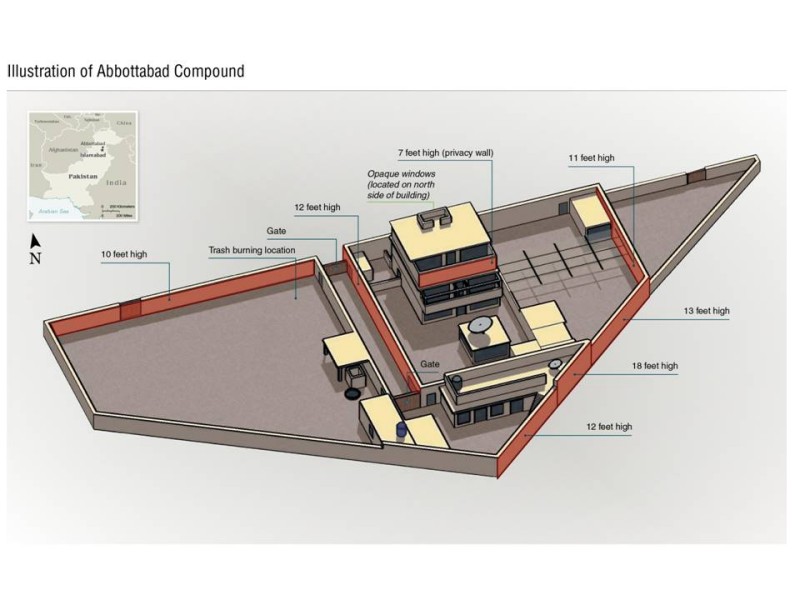
 |
| Diagram of Osama bin Laden's compound in Abbottabad, Pakistan |
Document: Abbottabad Commission Report [PDF]
Length: 336 pages
Document Date: Undated, released by Al Jazeera, July 8, 2013
Notes: 336 pages, but double-spaced and a fast read. Paragraphs are numbered, which is nice, and I refer to them below. Also, Osama bin Laden is referred to as OBL throughout. The released document is a PDF, though image-only, so text is not searchable or crawlable. All names are spelled as they appear in the report. Also, this is in the format I use for my Tumblr blog, Dumb Things I Have Read Lately, but I decided to post it here since it's way longer.
Commentary:
Since last week's release by Al Jazeera of the Abbottabad Commission's report on the May 2, 2011 US Special Forces raid on Osama bin Laden's compound in Pakistan, lots of folks have been trying to pick juicy tidbits from it.
For example, the Daily Mail noted that "Osama bin Laden wore a COWBOY HAT around the house to avoid detection." (Featuring an artist's conception of what Osama in a cowboy hat might look like.)
Beyond the goofy bits, the primary theme of the Abbottabod Commission's report is incompetence, at every level of government.
 |
| Image by Flickr user gemsling. Used under Creative Commons. |
In many cases, incompetence by individuals and lower-level government agencies is attributed to or exacerbated by systemic problems of ineffective institutions afflicted by corruption, conflict of interest, lack of policy guidance, and generally poor governance.
For example, the "incompetence" of a local police official, the Regional Criminal Investigation Officer, is attributed to "governance implosion syndrome." (p. 78, ¶152)
The report is breathtakingly harsh in its criticisms. It is a thesaurus of pejoratives for poor administration, including: Gross negligence, indifference, confused and incoherent, grave dereliction of duty, active connivance, unprofessional, grave lapse of professional judgment, woeful lack of efficiency, considerable ignorance, systemic failures, grossly irresponsible, shameful, dysfunctional, and policy bankruptcy.
Here are 36 other items from the report.
 |
| Image by Flickr user mikeoliveri. Used under Creative Commons. |
Like: Watching Plants Grow: "OBL personally saw to the religious education of his grandchildren and supervised their play time, which included cultivating vegetable plots with simple prizes for best performances." (p. 41, ¶49)
Escape by a Whisker: During his travels in Pakistan, OBL was clean shaven (p. 44, #55). It was also during this time that the car in which he was traveling to the bazaar was stopped for speeding by a policeman. All inside were free to go after the driver quickly settled the matter. (p. 45, ¶57)
No More TV for You: According to Maryam, wife of courier Ibrahim (al-Kuwaiti), her 9-year-old daughter Rahma was told that OBL didn't leave the house to go to the bazaar because he was too poor to buy anything, As a result, she then referred to him as "Miskeen Kaka" (poor uncle).
Rahma subsequently recognized OBL in a news report on al Jazeera, causing the ladies to then lose their TV privileges. (p. 47, ¶62-63)
In paragraph 73, the commission notes it did not find aspects of Maryam's testimony convincing.
Houseguest From Hell: Also according to Maryam, while they lived in Swat, they were visited for two weeks by a man named Hafeez, with his wife and seven children. A month later, they learned of his arrest, and his real name: Khalid Shaikh Muhammad. (p. 45, ¶58)
A Flood of Information? The Commission speculated that US pilots may have "directly or indirectly benefited from the US flood relief air operations of August-October, 2010 in the same general area" of the raid's inbound flight path, noting that the US had identified the Abbottabad compound by this time. (p. 52, ¶76)
Later, though, Director General Military Operations says during flood relief operations, US pilots were accompanied by Pakistani safety pilots to prevent deviation from planned routes. (p. 131, ¶281)
In several subsequent sections, the report similarly laments Pakistan's reliance on external assistance because of the vulnerabilities they introduce, most notably the notion that the CIA uses nongovernmental organizations as cover, exacerbated by the country's inability to properly track NGOs and their workers.
 The Cable Guy: This
is slightly ambiguous: Although the commission says the compound had "no
television cable or telephone lines" (p. 84, ¶149), it also says a
cable provider, prevented from using a wire on a pole next to the house,
used another pole instead. The cable guy, later watching a Discovery
Channel show about the raid, saw that OBL was watching an Arabic channel
that was not offered by that provider. (p. 60, ¶93)
The Cable Guy: This
is slightly ambiguous: Although the commission says the compound had "no
television cable or telephone lines" (p. 84, ¶149), it also says a
cable provider, prevented from using a wire on a pole next to the house,
used another pole instead. The cable guy, later watching a Discovery
Channel show about the raid, saw that OBL was watching an Arabic channel
that was not offered by that provider. (p. 60, ¶93)So, did OBL have both Dish and cable, or was the cable guy simply running the cable for a neighbor?
Foolproof Way to Cut Your Utility Bills: The utility company should have noticed that there were 4 gas meters and and 4 electric meters (supposedly for two families) feeding the OBL compound. The power outage was deemed a fairly transparent ruse to hide excessive consumption caused by the extra, hidden, family (bin Laden's), which could have tipped off authorities. (p. 60, ¶94)
Not a Fan of Children: Pakistani Army Major Amir Aziz, one of many Pakistanis skeptical that bin Laden actually lived in the compound for years, "expressed amazement at how 15-16 children of different ages could be confined and controlled for over five years when even 2-3 children are almost impossible to control and keep quiet." (p. 76, #128)
For other reasons, (p. 78, ¶134), the commission found the Major's testimony questionable.
Accurate, but Pathetic: The commission felt that the explanation why local police agencies failed to perform their investigatory duties (they were pushed aside by more powerful and capable agencies -- the military and ISI) was "an accurate but pathetic explanation." (p. 90, ¶164)
Do the Wrong Thing: "While there can be no excuse for this 'acceptance of realities' by senior officials [in the Home Secretary office of the civilian provincial administration], it has to be noted that they functioned in a very perverse political and administrative environment in which insistence on the correct performance of duty was often rewarded with severe punishment." (p. 98, ¶187)
Twitter as Forensic Tool: The Twitter posts by Shoaib Athar (@ReallyVirtual) were deemed to be "one of the most accurate account of events" because of the timestamps> (p. 79, ¶138)
What About Rent-to-Own?: The Inspector General Police, KPK (Kyber Pakhtunkhwa), felt that properties that were owned by their inhabitants were unlikely to house militants, on the "Assumption that militants would only rent but not buy properties." (p. 93, ¶170)
 |
| Bizarro Donald Rumsfeld. |
Bureaucratic Infighting Stops a Beating Heart: "NACTA [the National Counter Terrorism Agency, under the Ministry of Interior] was like a 'still born or aborted child.'" (p. 238, ¶576)
Hoo-ah! The commission found that the ISI investigating team, when faced with a statement by Maryam that there were unknown guests in the house shortly before the raid, dismissed it "as the nonsense of a woman." (p. 175, ¶400)
Government IT Contractors Say This Estimate Seems Low: The Pakistani Air Force Chief, when asked if the radar data from May 2 (which did not show unusual US aircraft activity) could have been manipulated, said that the PAF did not have the capability to change or manipulate the recorded data, which would take 30-40 people 6-7 weeks. (p. 154, ¶347)
Do You Call 311 or 911 to Report an Air Raid? The Air Chief also said there was no standard operating procedures to respond to phoned-in reports of incursions by hostile aircraft.
The Role of Landscaping in Counterterrorism: Trees by the OBL compound's boundary wall were cut down prior to the raid, leading some to suspect that covert CIA ground support agents did so to clear the approach for helicopters. Other reports said that OBL himself wanted them cut down to "prevent snoopers using them as cover." The Pakistani government believes a third theory, that a local landowner had them cut down and sold to pay school fees for her children. (p. 171, ¶387)
If You See Something, You Must Say Something: The Director General Military Intelligence (DG MI) felt "there ought to be a law requiring the public to inform law enforcement authorities about unusual happenings." (p. 186, ¶433)
I Want to Believe: Later, when asked about the possibility that bin Laden and his network were helped by rogue elments in the intelligence community, "The DG MI replied that 'there are no rogue elements in the intelligence establishment.' That was reassuring if not entirely convincing."
(p. 188, ¶439)
I Blame Obama: The Commission on the DG MI's assertion that if a terrorist is willing to sacrifice his life, he can't be stopped. "This, of course, is simply inaccurate. Suicide bombers may cause considerable loss of life, but in general do not have a high rate of success against VIP targets. Otherwise, people like President Obama should be long dead." (p. 190, ¶446)
On Waterboarding, Dryly: "While under detention in Pakistan, '[Khalid Shaikh Mohammad] was ill and did not divulge any information regarding OBL's location.' (He was reportedly "water boarded" almost 200 times by the CIA, which apparently had less concern for the state of his health.)" (p. 195, ¶459)
Because It's Worked So Well for the US: To combat the problem of intelligence sharing and stovepiping, "In the US, after 9/11, the Homeland Security Department (HSD) was established and all 17 security agencies were required to report to it. They all sat under one roof and met three times a day. Something like this was required in Pakistan." (p. 239, ¶582)
We Don't Think You're Completely Incompetent: On the remarks by Pakistan's Ambassador to the UK, who initially claimed the ISI and CIA worked together to trap OBL, then reversed himself: "Seldom has a High Commissioner made a more dishonest or absurd statement... The High Commissioner is an experienced diplomat... That is why, it is difficult for the Commission to dismiss his first statement as the utterance of a complete incompetent." (p. 249, ¶604)
But It Was Okay, Otherwise? On a Ministry of Foreign Affairs press release issued after the raid: "The above statement was truly shameful. It twisted and turned and went through all the convolutions of an acrobat to avoid explicitly condemning the US action and the violation of Pakistan's sovereignty, independence and territorial integrity. Indeed, the statement actually supported the American action by suggesting it achieved a common purpose. The statement dripped with confusion, fear, hypocrisy, deceit and insincerity." (p. 252, ¶609)
And Now for Noam Chomsky: The noted linguist and activist appears in the first of five paragraphs. (p. 259, ¶631)
Tell Us How You Really Feel: The commission refers to American private security contractor Raymond Davis, arrested for killing two Pakistani men he said were armed and threatening him, as "privately hired hitmen, goon thug" and "killer goon." (p. 266, ¶648)
 |
| Image by Flickr user benward. Used under Creative Commons. |
We Know You're Stupid, But Are You an Accomplice? On whether Pakistani intelligence or government was complicit: "Culpable negligence and incompetence at almost all levels of government can more or less be conclusively established by the testimonies of witnesses contained in this report. But connivance, collaboration and cooperation at some levels cannot be entirely discounted." (p. 287, ¶703)
The US as Unseen Enemy: Why did the possibility of unilateral US action come as a complete surprise? "The Pakistani military and political leadership displayed a degree of incompetence and irresponsibility that was truly breathtaking and indeed culpable." (p. 291, ¶710)
The US as Existential Threat: On being unable to stop a US incursion similar to the May 2 raid: "Submission to a military threat or military aggression from a militarily superior power without military resistance, whatever the military costs, has existential implication for Pakistan." (p. 292, ¶712)
Never Attribute to Malice: On why the ISI and others missed both the OBL and CIA support networks on the ground: "It was probably more a case of negligence, inefficiency and incompetence rather than complicity." (p. 299, ¶728)
We Failed to Recognize Your Pathology: On the May 2 raid as a major failure to protect Pakistan: The government failed to be aware of the "increasingly criminal and pathological nature of US policies," leading to "the greatest humiliation visited upon the country since its break-up in 1971" [when Bangladesh declared independence] (p. 301, ¶733)
The idea of the raid as a national humiliation for Pakistan, and the theme of the US "stabbing Pakistan in the back", recurs throughout the report.
The Rule, Not the Exception: On systemic failures in governance allowing lower-level incompetence that led to national tragedy: "May 2, 2011 was not a stand-alone failure. It did not represent an exception to the rule. It was the rule." (p. 305, ¶744)
Fences -- yes. Minefields -- no: The commission recommended several actions to strengthen border security. Besides stronger border controls throughout Pakistan to track the passage of foreign NGO employees, they also recommended increasing security on the border with Afghanistan. However, minefields were specifically recommended against. (p. 331, ¶783)
As a whole, the recommendations advocate for a series of broad measures to revamp the bureaucracy, eliminate corruption, redefine civil-military relations, and generally improve civilian governance and institutions.
Although I am not an expert in Pakistani internal politics, implementation of these recommendations seems unlikely.




 Posts
Posts


